
Water quality
Water Softener Installation & Repair in Desert Hot Springs, CA: Test the Water Before You Buy a System
White crust on faucets, spotted glass and a water heater that never lasts all point to hard water. Call Desert Hot Springs CA Expert Plumbers to talk through testing, install and repair; below is what a softener does and what it does not.
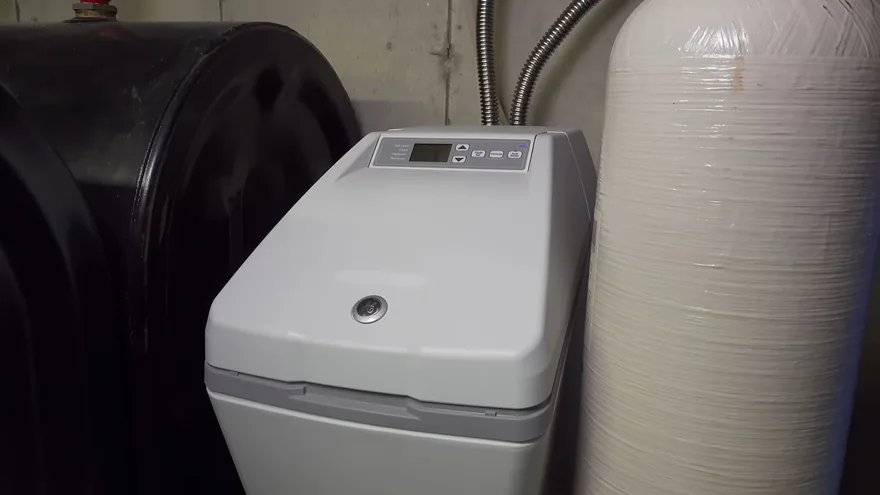
What hard water does around a Desert Hot Springs house
Hard water carries dissolved calcium and magnesium. When it is heated or left to dry, those minerals come out as scale. You see it as white crust on faucets and showerheads, spots on glass, stiff laundry and a tank water heater that rumbles or heats slowly.
Mission Springs Water District reports total hardness from 79 to 340 mg/L across its wells in its 2025 water quality report. By our conversion that is roughly 5 to 20 grains per gallon, a wide spread that depends on which well supplies your street. The district says it does not draw from the hot water aquifer, so this is ordinary mineral scale and not geothermal water.
Do you actually need a softener? Test first
Before you buy anything, find out how hard your water is where you live. A test strip from a hardware store gives a rough number. A water test from a lab gives a better one. Because the district's range is so wide, a neighbor's result may not match yours.
The district publishes its annual report, and the account line at (760) 329-6448 can tell you which source serves your address. A plumber should test your tap and tell you the number before quoting a system. If the first thing a seller does is quote a size without testing, ask why.
How a softener works, and what it does not do
A softener holds resin beads that trap calcium and magnesium and release sodium or potassium in their place. When the beads fill, the unit regenerates by flushing them with brine, then rinses and starts again. That cycle uses salt and water and drains to a place you have to plan for.
| A softener does | A softener does not |
|---|---|
| Remove hardness minerals from the water that passes through it | Remove chlorine, taste, odor or sediment on its own |
| Reduce scale on heaters, fixtures and glass | Make the water drinking-water filtered |
| Help soap lather and laundry feel softer | Change how much water the district delivers |
| Need salt and regular checks | Run without a drain and a power outlet |
If you also want better taste or sediment removal, that is a filter's job. See whole-home filtration for how the two differ and how they are combined.
Scale on every fixture and a heater that never lasts?
Tell us what you are seeing and which fixtures, and we will say how to test the water and what a fair plan looks like.
Sizing, placement and what the install includes
A softener is sized by the hardness of the water and how much your household uses, so that it regenerates at a sensible interval. Too small and it runs out of capacity between regenerations. Too large and it wastes salt and water.
- Where the unit will sit, and whether there is room, power and a drain nearby.
- A bypass valve, so that you can isolate the unit for service.
- Where the regeneration water drains, and whether it is allowed to go there.
- Whether the system softens all water or leaves a line for outdoor use and drinking.
- The warranty on the tank and the control valve.
Ask about outdoor taps. Softened water on a lawn is wasteful and can harm plants, so many installs leave the hose bibs on untreated water.
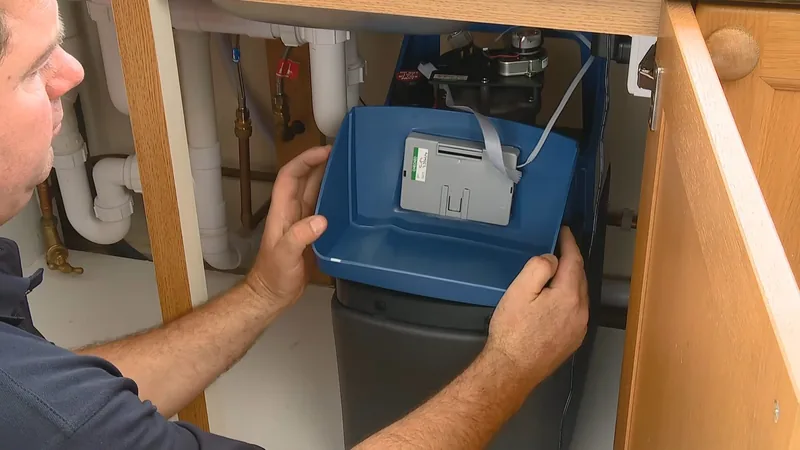
What to expect after the install
A softener is not a set-and-forget device. Salt needs topping up, and the brine tank needs an occasional check for bridging or buildup. The control valve has settings for hardness and regeneration, and they should be set to your test result.
Softened water also feels different. Showers can feel slick at first, because soap rinses away more fully. If you have a heater with scale already in it, the tank may need a flush to clear it. See scale inside the tank and descaling a tankless unit for what that involves.
Softener repair: signs something is off
Most softener problems show up the same way: the water is hard again. A short check before you call can narrow the cause.
- The brine tank has no salt, or salt has formed a crust that keeps it from dissolving.
- The unit has lost power or the control settings were reset.
- The bypass valve is open, so water goes around the unit.
- The resin is old and no longer holds hardness minerals.
- A drain or injector is clogged and the unit cannot regenerate.
Ask the plumber to test the water before and after the unit, and to tell you which of these it was. Resin and valves wear out, and an older unit may be worth replacing instead of repairing.
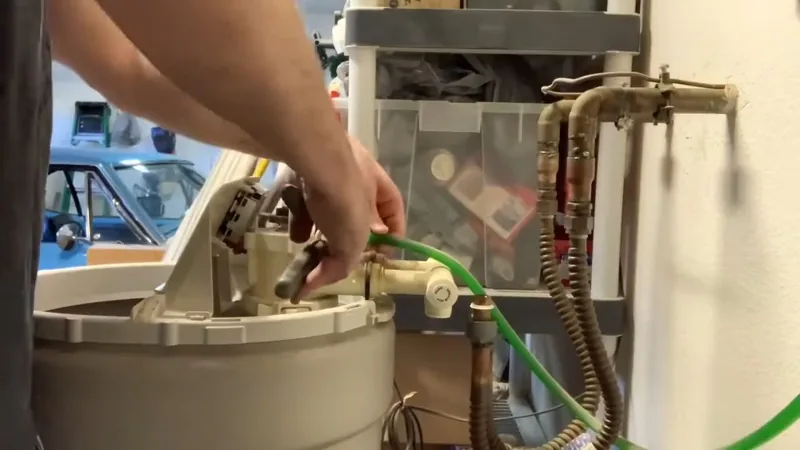
Sodium in softened water: a question for your doctor
Softened water contains more sodium than the hard water it came from, in proportion to how hard the water was. Whether that matters for you is a question for your doctor, and not for a plumber. If it does, ask about potassium instead of sodium, or about leaving one tap, such as the kitchen, unsoftened.
This site does not give health advice about water. Read the district's annual report for what is in your supply, and talk to your doctor about anything specific to you.
Questions to ask before you buy a softener
A short list will sort out a straightforward quote from a sales pitch:
- What is my water's hardness at my address, and how was it measured?
- How was the unit sized, and how often will it regenerate?
- Where will the regeneration water drain?
- What does the warranty cover on the tank, the resin and the valve?
- What are the salt and water costs each month?
- License details are available on request before work begins; can I have yours?
Water softener questions, answered
How hard is the water in Desert Hot Springs?
Mission Springs Water District's 2025 report lists total hardness from 79 to 340 mg/L, which is roughly 5 to 20 grains per gallon by our conversion. It varies by well and by street, so test your own tap.
Will a water softener make my water safe to drink?
A softener removes hardness minerals. It does not filter taste, chlorine or sediment, and it is not a purification system. For those, look at filtration, and read the district's annual water quality report.
Hard water wearing on your home? Call about a softener
Tell us what you see on fixtures and the heater, and we will say how to test and what a fair plan includes.